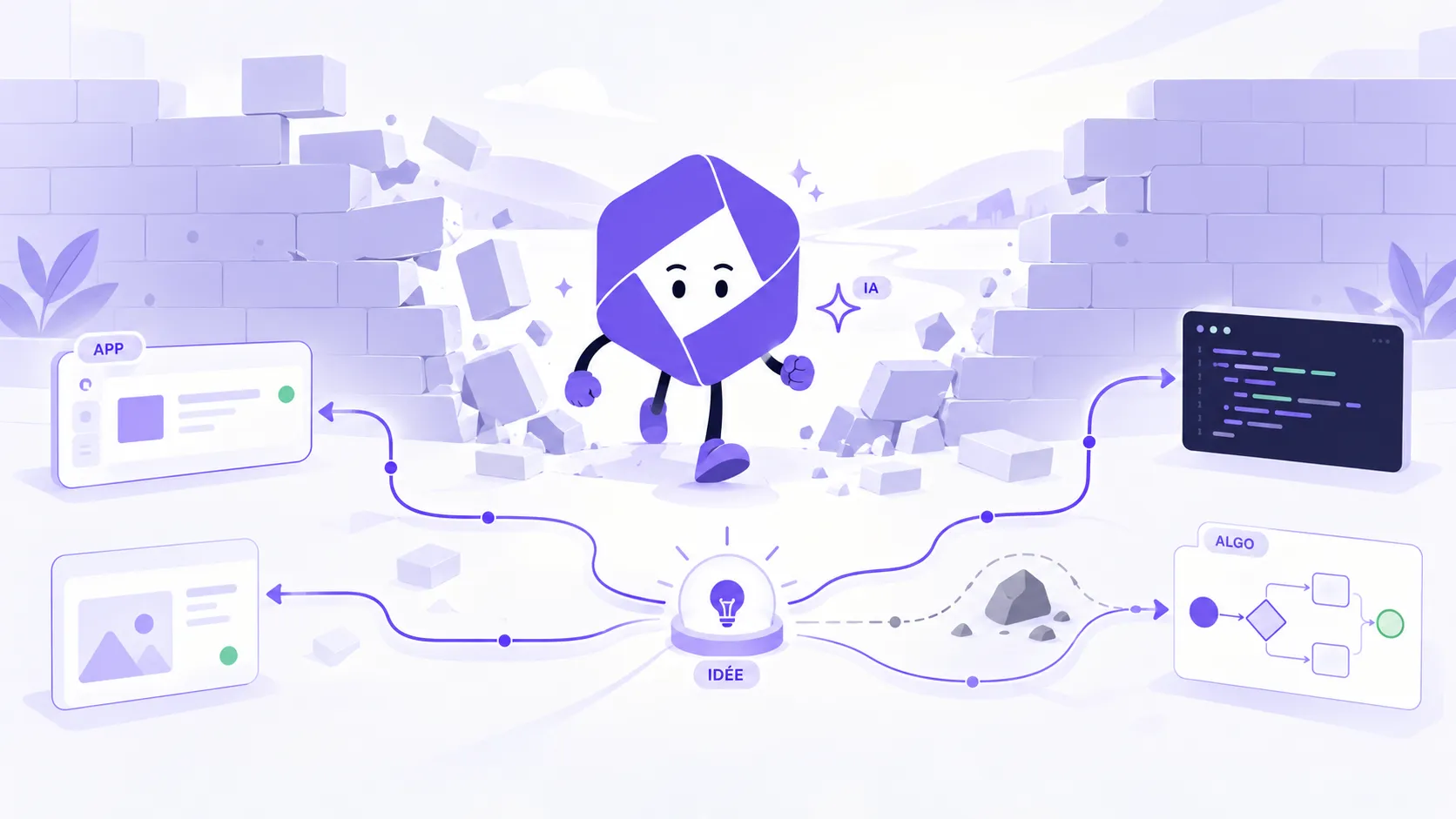
For a long time, a software idea started with a doubt. Before even knowing whether it was worth anything, I wondered whether I would manage to build it: which technology would allow it, which algorithm it would take. The first question wasn’t “is this a good idea?” but “can it even be built?”.
That question has almost disappeared.
The answer is almost always yes
Today, with AI, the answer comes very quickly, and with fairly solid confidence. In 99% of cases it is yes, one way or another. When the direct path is closed, there is almost always a roundabout one. Sometimes a different goal shows up along the way, close to the first, that I hadn’t thought of.
The order of the questions has flipped. I no longer start from what I know how to do to decide what I can build: I start from the idea.
Technology becomes secondary
My background is TypeScript, Vue and Nuxt. I had never used Astro. Yet this site is built with Astro, and less than a week passed between the first commit and going live.
CBTicket, my ticket-tracking tool, runs on React and Next.js. I had used the first only a little, the second never. From the idea to the first production release, it took about ten days.
In both cases, I didn’t pick the technology I knew. I picked the one that fitted, once the goals were clear.
Even algorithms are no longer a wall
I have a product idea in mind that belongs to operations research: a problem from the travelling-salesman family. It is exactly the kind of idea that used to raise the question of whether it could be done. Today, I know that implementing those algorithms will not be what holds it back.
What stays out of reach
There remains the 1%. These are the projects where you sense intuitively that a physical limit exists, before writing a single line of code.
Everything else is open.
The paradox of the moment
The job market tells a different story, though. In France, according to Apec, job postings for developer roles fell by 20% in 2025. Across IT as a whole, Hellowork measures 28% fewer postings over the same year, nearly three times the decline of the market overall. After years of full employment, the sector is discovering worry.
The contradiction is striking. An experienced developer can now bring almost any idea to life. And it is at that very moment that they risk no longer finding the setting to do it in: a position, a team, a hire.
Many then turn to independence. The number of freelancers keeps climbing, and competition with it: more profiles are going after the same assignments. Independence is not an automatic refuge.
Choosing optimism
There are two ways to look at AI. You can fear it, and tell yourself it will take your job. You can also see what it opens up.
If you are a developer, the question is no longer “will I know how to do it?”. If you have a project, it is no longer “can it be done?”. Either way, the only question that matters remains: is this idea worth building?
Sources (in French): Apec, as reported by
Le Monde Informatique
(February 2026); Hellowork, as reported by
L’Essentiel de l’Éco
(April 2026).